My Research


Exploring Migration: Lived Experience, Belonging, and the Redefinition of Home
I study the experiences of Latino voluntary migrants as they adjust to a new country, viewing migration as an ongoing process in which identity, belonging, and home are continually redefined. Drawing on phenomenology, narrative inquiry, acculturation theory, and transformative learning theory, I examine how individuals interpret their migration, preserve memories, and construct new forms of belonging. My research focuses on listening deeply, as stories shape change.
Research Approach, Design & Journey
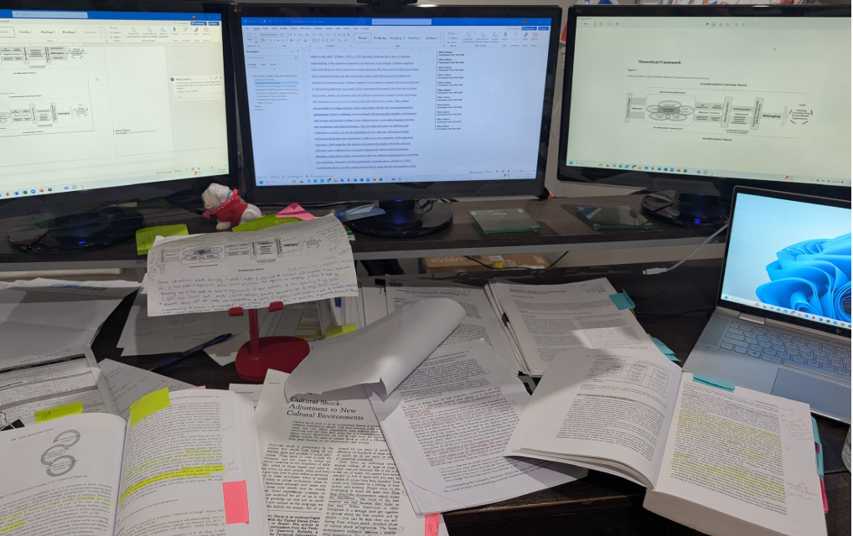
This study used a phenomenological design guided by Reflective Lifeworld Research (RLR) to explore the lived experiences of Latino voluntary migrants as they acculturate to the United States. Phenomenology seeks to understand the essence of a phenomenon from the perspective of those who experience it, not as a linear process but as a dynamic, emotional, and emergent one. I used Reflective Lifeworld Research (Dahlberg, 2008) because it allowed meaning to surface through openness, reflection, and intentional restraint of assumptions, known as bridling. This research unfolded not only as an analytical process but as a deeply personal and emergent journey. During the interviews, silence, laughter, tears, and hesitation were treated as meaningful expressions rather than interruptions, each carrying insight into how migration is felt, remembered, and narrated. Through this process, it became evident that migration is not a movement from Point A to Point B but a lifelong negotiation of belonging, language, identity, and the ever-evolving meaning of home.
Reflective Lifeworld Research (RLR) Guided the Study
Reflective Lifeworld Research (RLR) was chosen as the methodology for this study because it best aligned with the purpose of my research: to explore the essence of migration as a lived, emotional, cognitive, and relational experience. Unlike grounded theory or other linear approaches, RLR acknowledges that migration and belonging are not predictable stages but emergent, evolving, and often nonlinear processes. At its core, RLR prioritizes lived meaning, asking What does it feel like to live this?
As both a migrant and a researcher, I applied the practice of bridling, slowing down assumptions, and remaining open to participants’ words, silences, contradictions, and emotional expressions. This approach treats subjectivity not as a threat to validity but as a reflective tool that deepens understanding while keeping participants’ voices at the center. Using RLR shaped every research stage: narratives were analyzed holistically, with meaning units emerging naturally, including silence, tears, hesitation, and laughter, which were treated as meaningful data. Theory followed experience, yielding organic insights rather than fitting into preset frameworks.
Research Design
This study used Reflective Lifeworld Research (RLR), a phenomenological approach that values the complexity of human experience. Instead of starting with fixed hypotheses, it let meaning emerge through participants’ stories. The aim was to understand migration not just physically but also in terms of memory, identity, and belonging. This fit the dissertation's goal: to explore migration and acculturation from those who experience it, while staying open and “bridling” to keep interpretations true to their voices. The research involved ethical recruitment, semi-structured interviews, reflective migration timelines, journaling, and whole–parts–whole data analysis. This approach examined migration as a dynamic, nonlinear process influenced by emotion, culture, and learning.
Participant Sample
The sample comprised Latino voluntary migrants whose experiences formed the core of this study. Participants were selected based on the following criteria: they migrated voluntarily to the U.S. as young adults, lived in the U.S. for at least three to five years, navigated acculturation firsthand, and were non-native English speakers upon arrival. They came from Ecuador, Mexico, Panama, and Venezuela, representing diverse ages, professions, education levels, family types, and lengths of time in the U.S. Although their journeys differed, they shared the experience of reconstructing identity, language, and home in a new culture. Recruitment was conducted through community networks, outreach, and referrals, building trust that encouraged the sharing of personal stories. Their narratives, marked by resilience, loss, hope, and transformation, formed the foundation of their migration experiences.
The Meaning-Making Process
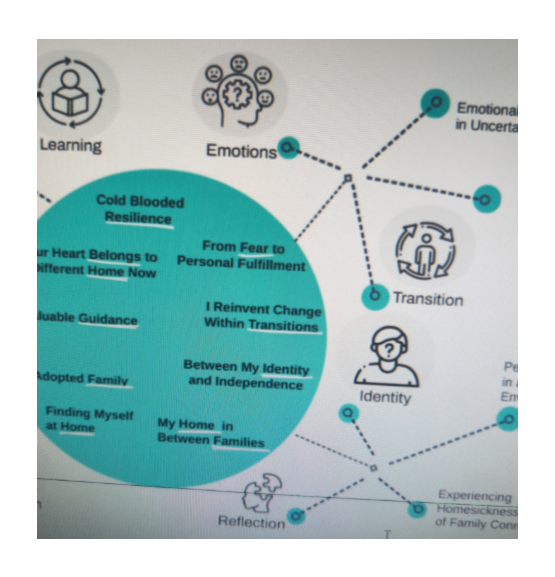
Data analysis followed Dahlberg’s whole–parts–whole approach, allowing themes to emerge naturally from participants’ lived experiences. I first listened to each interview in full to immerse myself in the stories without interpretation or judgment. Then, I carefully segmented transcripts into meaning units, noting emotions, pauses, metaphors, and subtle moments of tension or insight. These units were color-coded to highlight recurring themes such as loss, identity, silence, language, learning, and redefining home. As patterns emerged, themes clustered around concepts such as edge emotions (fear, shame, courage), unlearning and relearning the self, and viewing home as memory versus a conscious choice. Lastly, I revisited the full narrative to confirm that these themes were rooted in participants’ voices, free from my assumptions, thereby maintaining the authenticity and complexity of their stories.
Publications
Velazco, M. (2025). [in]Transit: Transformative Learning in Latino Voluntary Migrants Acculturating to the United States. Revista Red Iberoamericana De Escuelas Judiciales 1 (1), 11-28.
Velazco. M. (2025). [en]tránsito: Aprendizaje transformador en migrantes latinoamericanos voluntarios que se aculturizan en los Estados Unidos. Revista Red Iberoamericana De Escuelas Judiciales 1 (1), 11-28.
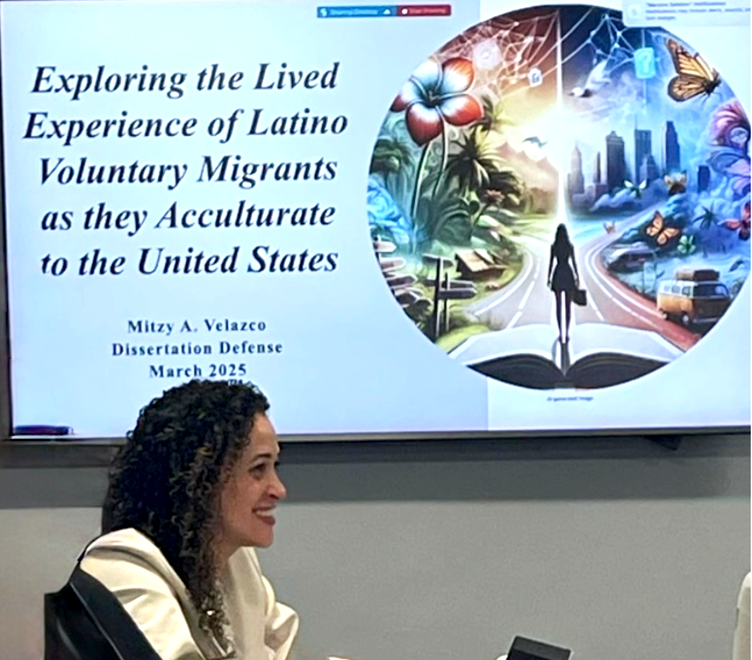
Velazco, M. (2025). Exploring the Lived Experience of Latino Voluntary Migrants as They Acculturate to the United States (Doctoral dissertation, University of Georgia).
Velazco, M. (2024). Navigating cultural transition & uncertainty: An autoethnographic exploration of a transformative learning journey as a Latina voluntary migrant. Proceedings of the XV Biennial International Transformative Learning Conference. 742-749.